I
Inevitability
The concentration of population, infrastructure, governance, and strategic objectives within urban environments makes urban operations an enduring military requirement.
FORTIS NOVUM MUNDUM / VOLUME I — DOCTRINE
A Manual for Military Operations on Urban Terrain
THE CITY IS NOT A SURFACE.
IT IS A LAYERED BATTLESPACE.
A doctrinal framework for understanding conflict across streets, structures, subterranean networks, and the invisible dimensions of modern warfare.
Contemporary military doctrine is not fully aligned with the environment in which modern urban conflict unfolds. Planning frameworks continue to rely heavily on two-dimensional representations of terrain, while actual operations extend through interconnected physical structures and non-physical domains.
The argument is not that urban doctrine does not exist. It is that integration remains the defining institutional challenge.
“The city is not a surface.
It is a volume.”
Select a physical level. Then introduce the invisible dimensions. The operational picture changes not because the city moves, but because more of its relationships become visible.
High-rise rooftops, antennas, civilian and military observation, low-altitude airspace, and surveillance infrastructure form the city’s exposed upper edge.
Elevation changes what can be seen—and what can be hidden.Functional dimensions, not additional floors. Combine them with the physical city.
Physical terrain and non-physical dimensions interact continuously. Understanding one without the others produces an incomplete operational picture.
IT IS STRUCTURALLY
DIFFERENT.
The concentration of population, infrastructure, governance, and strategic objectives within urban environments makes urban operations an enduring military requirement.
Dense construction, civilian presence, verticality, underground infrastructure, and information saturation create interacting challenges—not ordinary terrain constraints.
The operational challenges of a megacity differ fundamentally from smaller urban engagements. Increasing the size of conventional formations does not automatically resolve the problem.
Physical control is only part of the urban problem. Intelligence, communications, information, human judgment, and sustainment collectively shape operational outcomes.
Establishes the contemporary urban warfare problem, the nature of the environment, and the legal and ethical framework governing military action.
Why urban combat is the baseline condition of modern warfare, and where doctrinal consensus still falls short.
Density, verticality, subterranean extension, civilian presence, and the city as an active operational system.
Distinction, proportionality, responsibility, and lawful decision-making under urban compression.
A reference work designed for consultation, sequential reading, and professional study.
Get the complete manual“Modern military forces enter cities with conceptual models designed for terrain that no longer exists.”
The geometry of the fight is not linear. It is stacked, compartmentalized, and internally connected in ways that render surface-based representations insufficient.
Recent conflicts do not provide a single template for the future. They reveal a recurring condition: the city as an integrated physical, human, and informational system.
Dense construction, subterranean movement, civilian presence, and the scale of clearance exposed the limits of surface-based models.
URBAN / OBSERVEDA prolonged urban engagement demonstrated how structures, endurance, information, and force protection interact.
URBAN / OBSERVEDHigh-intensity combat made the city simultaneously a physical, informational, electromagnetic, and human battlespace.
URBAN / OBSERVEDAttrition, observation, fires, and decision compression reshaped the operational meaning of terrain.
URBAN / OBSERVEDHistorical analysis, not classified intelligence. No gruesome imagery. No fabricated certainty.
The first volume establishes the conceptual framework. The second addresses its tactical application.

A professional reference on the relationships between doctrine, terrain, technology, command, sustainment, and institutional adaptation.
INDEPENDENT PUBLICATIONThis is an independently published work of military analysis. It is not an official Department of Defense field manual and is not endorsed by any armed service or government agency.
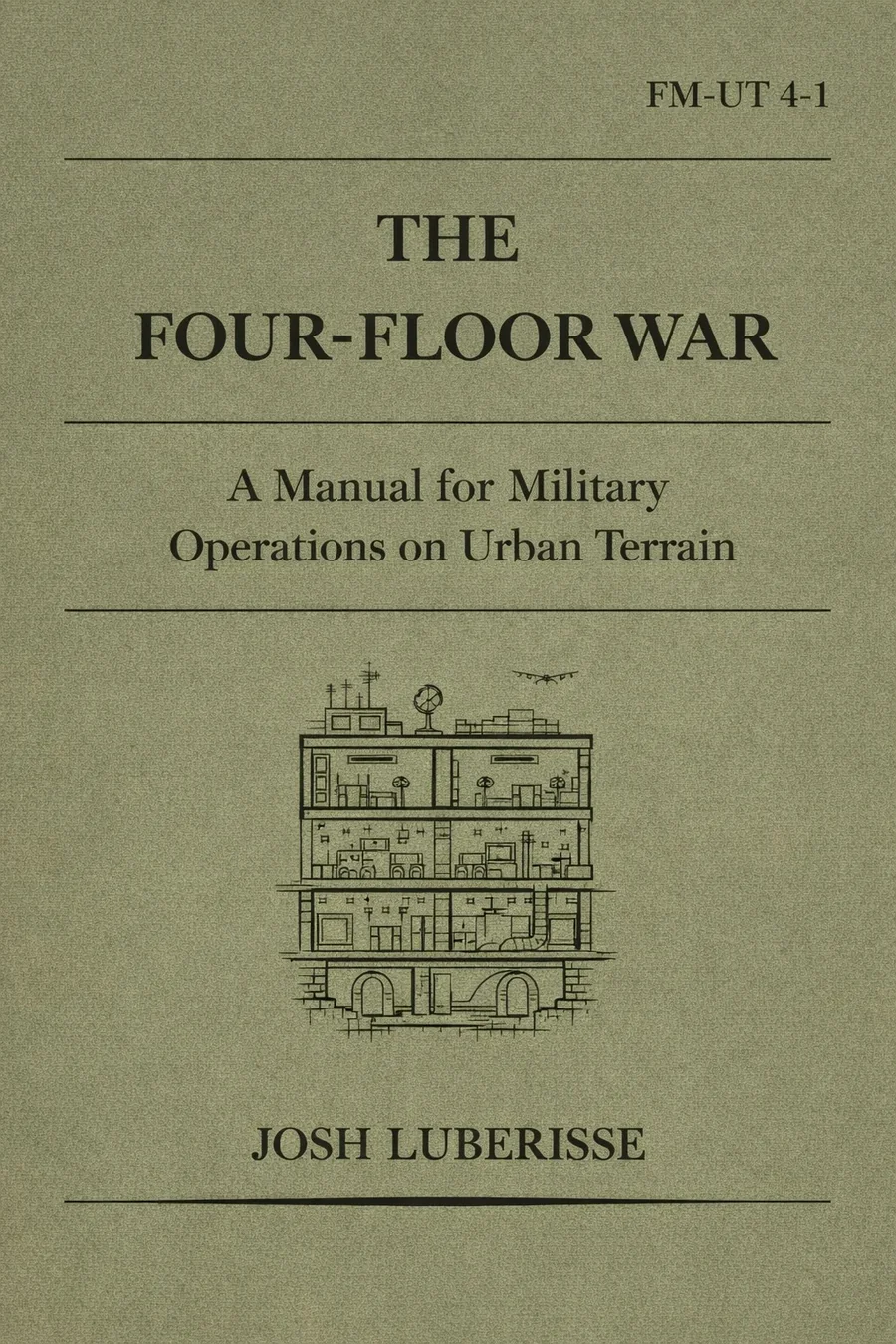
A Manual for Military Operations on Urban Terrain
Nineteen chapters. Four parts. A doctrinal framework for the layered city and the integrated realities of modern urban warfare.
Get the Book on Amazon Explore the Companion Volume Institutional & Academic InquiriesDirect answers about the framework, the intended audience, and how the manual relates to official urban operations doctrine.
The Four-Floor War establishes a framework for understanding military operations in a world where the city is no longer merely terrain, but an interconnected operational system.